Note 01 / plant structure
Read a date palm from crown to ground
The familiar silhouette becomes more informative when crown, frond, fruit, trunk surface and offshoot are treated as separate visible structures.

Start at the top. A date palm carries new growth at a single crown, where leaves emerge around the growing point. The overall form may look circular, but individual fronds occupy different ages and angles. Upright inner leaves are generally younger; older leaves tend to extend outward and downward. Pruning and wind can alter this arrangement, so crown shape should not be read as a fixed natural diagram.
Follow one frond
Date-palm leaves are pinnate: many narrow leaflets attach along a central axis. From a distance, this creates the feather-like form that distinguishes the palm from fan-leaved species. Near the base, some leaflet structures are stiff and spine-like. There is no reason to touch them for confirmation. A clear view or photograph is safer for both observer and plant.
Look for colour differences cautiously. Dust, backlighting, age, water stress, image processing and dead leaflets can all shift the visible tone. A greener crown is not enough to identify a named variety or diagnose the palm’s condition.
Crown-to-ground scan
1. Inner and outer frond angles. 2. Flower or fruit structures below the leaves. 3. Leaf-base pattern on the trunk. 4. Offshoots or vegetation near the base. 5. Water, soil and access around the palm.
Fruit hangs below the crown
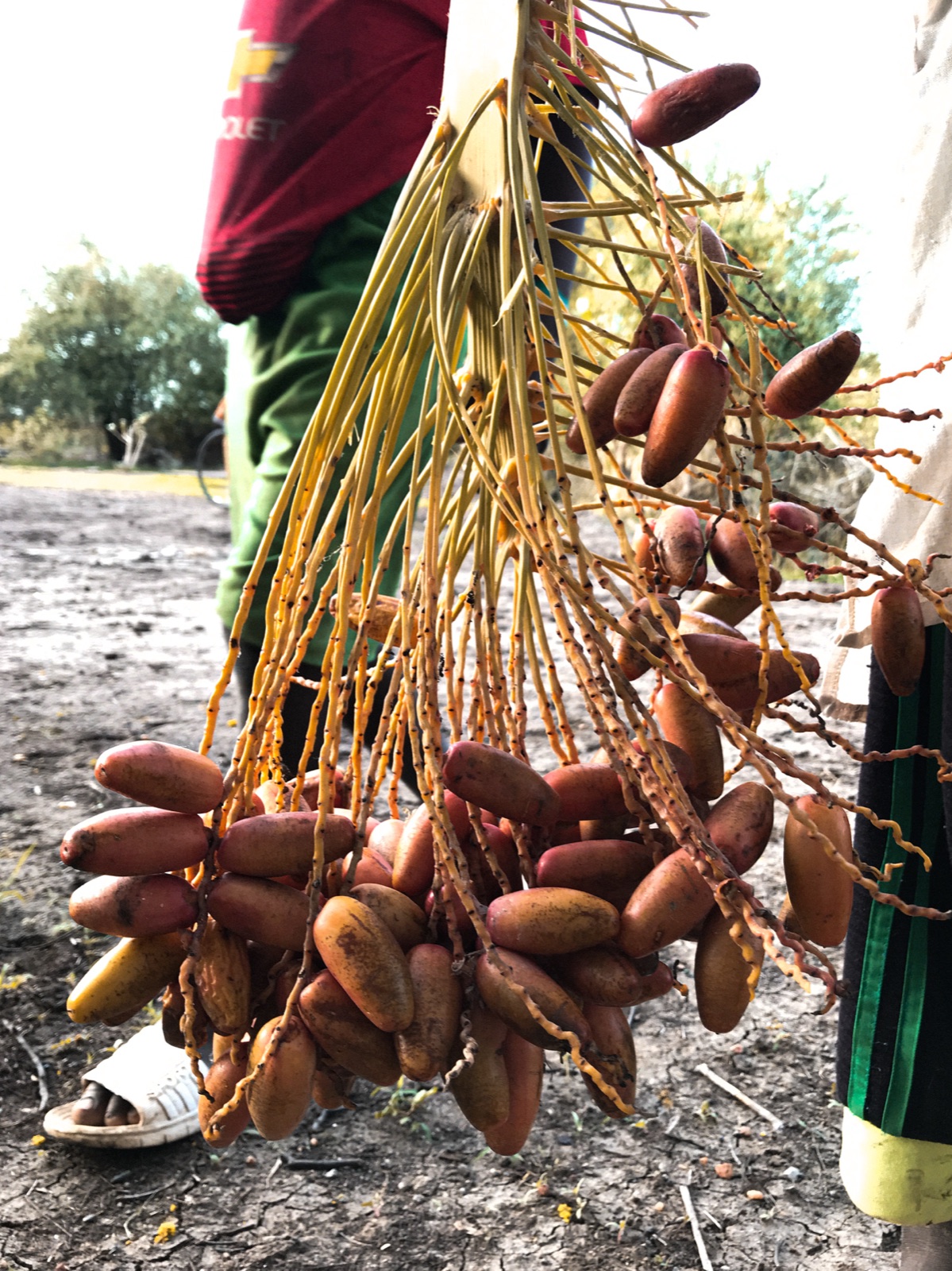
Flower clusters emerge among the leaves, and fruit develops on branched strands that hang beneath the crown. Date palms are dioecious: male and female flowers are normally borne on separate plants. Fruit on one palm therefore does not mean every neighbouring palm will carry a crop. In cultivation, pollination is often managed rather than left entirely to chance.
Fruit colour and softness change during development and ripening, but a photograph cannot safely establish cultivar, taste, harvest readiness or commercial grade. Light can exaggerate yellow, red or brown, and bunches on the same palm may not look identical. Describe density, colour range and position before reaching for a name.
The trunk records leaf attachment
A palm trunk is not a branching woody trunk with annual growth rings like those of many broadleaf trees. Its surface often preserves a repeating pattern where old leaf bases were attached or cut. Pruning style and age affect how rough, stepped or cleaned that surface appears. The pattern is evidence of growth and maintenance, not a calendar that a casual observer can count.
Never climb a palm or pull at old leaf bases. Work at height requires specialised skill, equipment and local practice. A visitor should remain outside the work zone.
Look for offshoots at the base
Date palms can produce basal offshoots, especially during earlier phases of growth. In cultivation, selected offshoots can be used for vegetative propagation, which preserves the characteristics of the parent plant more predictably than a seedling. Whether an offshoot will be retained or removed is a management decision invisible to an outsider.
Seedlings, weeds and other planted species can also occupy the base. Do not label every young palm-like shoot as a deliberate offshoot without checking its point of connection.
Scale changes what you can say
A full-palm view is best for crown balance, trunk height and the plant’s relation to paths or water. A closer view can clarify leaflet arrangement, fruit strands or the cut pattern of old leaf bases. These are different records, not interchangeable evidence. Keep a wide frame beside any detail so the detail does not lose its position.
Distance also protects accuracy. Heat shimmer can soften a high crown, while a telephoto view can visually compress separate palms and make their leaves appear connected. Note the viewing direction and obstruction when they affect interpretation. If the growing point, fruit attachment or base cannot be seen, mark it as hidden instead of reconstructing it from expectation.
End with the managed setting
Step back and connect the plant to spacing, irrigation, paths and neighbouring crops. A solitary roadside palm, a Nile field edge and a dense Siwa orchard present different management contexts. The same species can be pruned, watered and accessed in different ways.
The best field note keeps these scales together: feathered frond, organised crown, pendant fruit, patterned trunk and cultivated ground. It also keeps its limits. Variety, ownership, yield and health require evidence beyond a quick view.